


Literacy and Reading
At Gracewood Academy, reading is everyone’s responsibility. We believe every child should leave school reading at their chronological age, we call this the Reading Guarantee. Through our Reading Guarantee, we ensure that every student, regardless of background, leaves school as a confident, fluent reader. This is not about simply catching up; it is about unlocking the full curriculum and empowering students to thrive academically, emotionally, and socially.
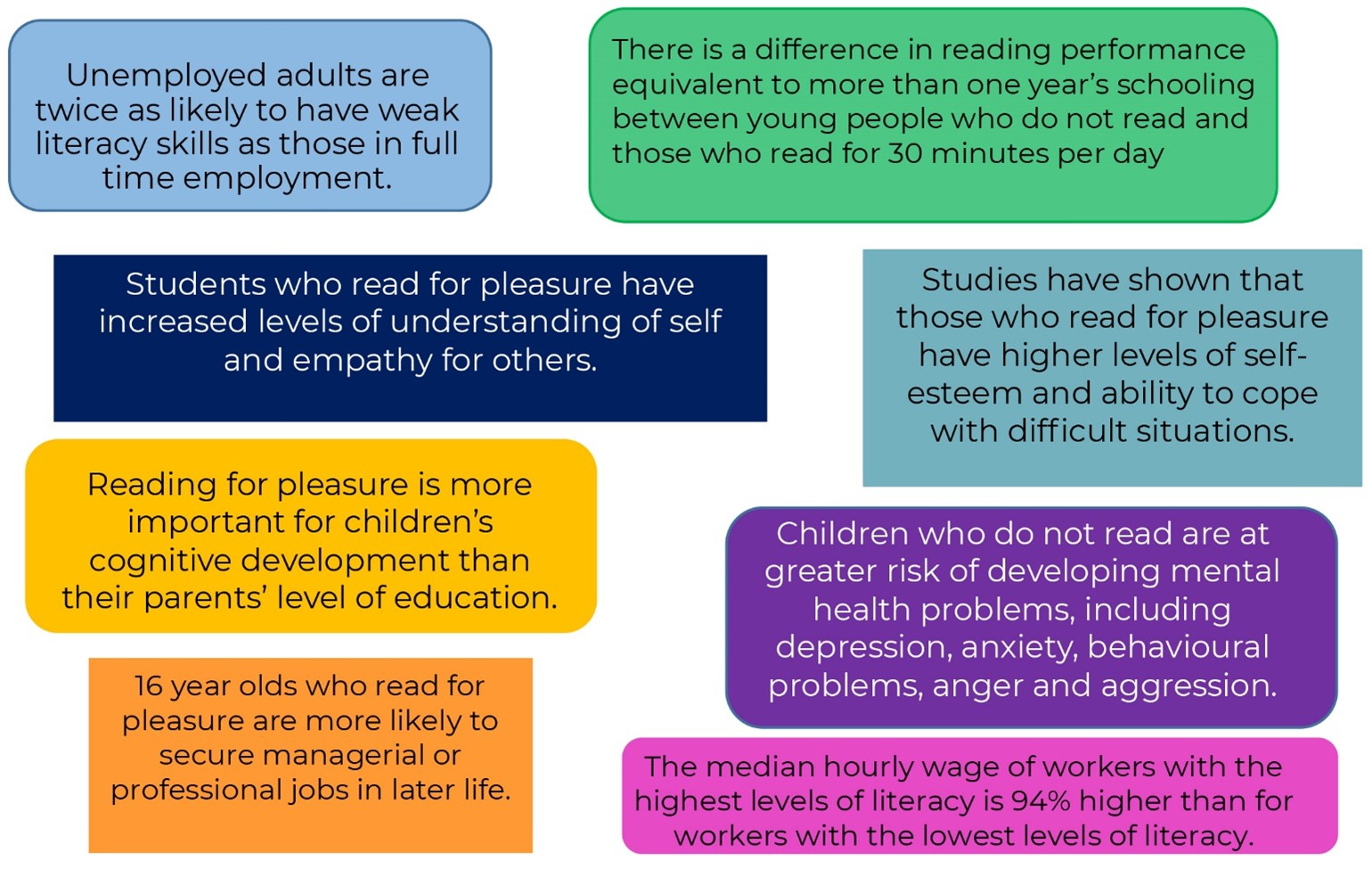
Research consistently shows that engagement with reading is one of the strongest predictors of future success. Reading develops cognitive function and shapes individuals who are articulate, informed, empathetic, and confident - qualities essential for both achievement and wellbeing.
Literacy in the Curriculum
We understand that literacy goes far beyond the basic ability to read and write. It includes the cultural knowledge required to access complex texts, the resilience to tackle academic challenge, and the rich vocabulary needed to interpret meaning and express ideas with clarity. Literacy is therefore the collective set of skills and knowledge that enable students to read fluently, write effectively, and speak with confidence.
Crucially, we recognise that literacy looks different across disciplines. Being literate in science is not the same as being literate in history or mathematics. For this reason, we do not adopt a one-size-fits-all approach. Instead, subject teams are trained to design curricula and lessons that explicitly teach the literacy skills required for success in their subject. Literacy is not a bolt-on; it is embedded through excellent curriculum design, high-quality teaching, targeted intervention, and a strong whole-academy commitment.
What does this mean for us at Gracewood Academy?
At Gracewood we:
- Read for 30 minutes in tutor time three times a week
- Read academic texts in all lessons
- Are exposed to fiction and non-fiction throughout the curriculum
- Actively engage in discussions about what we are reading
- Actively engage in Sparx Reader for Home Learning to support our reading
- Praise and reward those who achieve at Sparx Reader with our leader board
- Have a targeted reading scheme led by the inclusion team to support the weakest readers
- Encourage and foster a love of reading in all areas
- Have recommended Reading Lists for all year groups along with challenge lists to widen our cultural literacy.
The Future Reading Programme
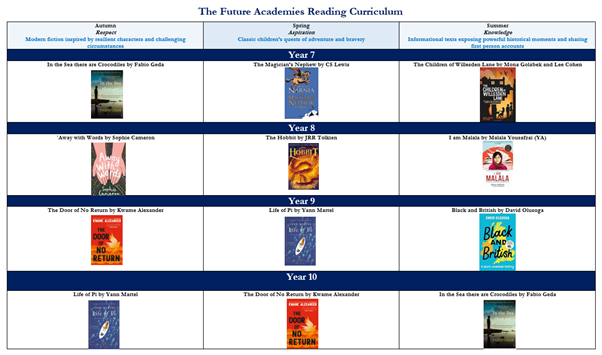
The Reading Curriculum has been designed to keep teenagers reading and accessing quality texts and stories from different cultures, transitions, and time periods. By reading to them, we are able to supplement the text with valuable context that boosts student knowledge and understanding, drawing links and parallels to content in the wider curriculum and fostering a love of reading for pleasure.
The Future Canon
The texts students read in the canon of the Reading Programme have been carefully curated to consider a range of challenges. Firstly, we have used the ‘5 plagues of reading’ which Doug Lemov specifies in his text ‘Reading Reconsidered’ children to ensure a diversity of choice. Lemov highlights that students should have access to these 5 ‘plagues’ throughout their school lives in order to better comprehend the more challenging texts expected of them in secondary school and beyond.
1.) Archaic Texts 2.) Non-Linear Time Sequences 3.) Narratively Complex 4.) Complexity of Plot/Symbolic 5.) Resistant Texts
Secondly, leaders in school have collaborated on these choices with The Literacy Team at Future Academies to ensure the books complement the contextual safeguarding and PSHE needs of the school to ensure the stories explored have real value for the young people exploring them. Finally, the syntactical challenge, reading age and richness of tier 2 vocabulary has been considered to ensure students read rich materials that develop their vocabulary. Each text has been complemented by non-fiction reading and poems to ensure students not only explore prose but develop ability to read non-contiguous texts to develop fluency in their reading too.
Reading Support
Alongside our curriculum and explicit teaching of literacy in subject areas, we provide targeted interventions to ensure every student receives the support they need. These include:
- Fresh Start Phonics
- Literacy Gold
- Rapid Plus
- Flash Academy for students new to English
As George R. R. Martin reminds us, “A reader lives a thousand lives before he dies.” At Future Academies, we are committed to ensuring every student has the opportunity to explore those lives, and their own future, through the power of reading.
Why is Reading so important?
How can you support your child to read at home?
Talk your Child about Books
- Ask your child about the book they are reading in tutor time.
- Chat about characters, predict what might happen next, and show enthusiasm for the story.
Try a Family Activity Linked to Their Reading
- Many texts in term one focus on refugee stories and families. You could create a simple family tree together and talk about your own family story.
- In term 2 the focus is on adventure novels and classics, you could design your own myths and monsters at home.
- In term 3, students read about non-fiction such as I am Malala, you could read a newspaper or watch the news together and then create your own articles or speeches about current events.
Read Together at Home
- Build 20 minutes of reading together into the evening routine - great for winding down and reducing screen time.
- Visit our wider reading canon and choose a book to enjoy as a family; borrow it from the school or local library.
Use questions to Boost Understanding
Try asking:
- “What do you predict will happen?”
- “What questions do you have about this character?”
- “What does this word mean?”
- “Can you summarise what happened?”
Speak with us anytime
- Our team is always here to share strategies and support your child's reading at home.
National Literacy Trust (excellent free parent resources)
- Parent site “Words for Life”: Tips, activities, and book lists for ages 0–12.
https://literacytrust.org.uk/parents-and-families/ [literacytrust.org.uk]
BookTrust (advice, book recommendations & reading help)
- Practical reading tips for parents.
https://www.booktrust.org.uk/resources/find-resources/reading-tips/ [booktrust.org.uk]
Local Libraries in Potters Bar
Your nearest local library is:
- Oakmere Library (Potters Bar)
High Street, Potters Bar, EN6 5BZ
Opening hours & services available here:
https://www.hertfordshire.gov.uk/services/libraries-and-archives/library-opening-hours/oakmere-library.aspx [hertfordshire.gov.uk]
Libraries offer:
- Free book borrowing
- Children’s activities and rhyme times
- Reading recommendations
- Digital books and audiobooks
Our Reading Recommendations by Year
Year 7 recommendations
- Fight Back by A.M. Dassu
- Can you see me? By Libby Scott and Rebecca Westcroft
- Peregrine Quinn and the Cosmic Realm by Ash Bond
- Freedom (1783) by Catherine Johnson
- His Dark Materials Series by Philip Pullman
- The Hunger Games by Suzanne Collins
Year 8 recommendations
- Catch Your Death by Ravena Guron
- Like a Girl by Rebecca Westcroft
- Thirteen by Tom Hoyle
- Rugby Flyer by Gerard Siggins
- Wink by Tom Harrell
- Kerb-Stain Boys by Alex Wheatle
Year 9 recommendations
- Kind of Nothing by Nathanael Lessore
- One of Us is Lying by Karen M. McManus
- Lionheart Girl by Yaba Badoe
- Are you there, God? It’s Me, Maragaret by Judy Blume
- The Twilight Saga by Stephanie Meyer
- Thief by Malorie Blackman
Year 10 recommendations
- On the Edge by Nicola Garrard
- The Kill Factor by Ben Oliver
- Crossing the Line by Tia Fisher
- The Fault in our Stars by John Green
- As Far as You’ll Take Me by Phil Stamper
- We Are All Made of Molecules by Susin Nielsen
Year 11 recommendations
- Last Lesson by James Goodhand
- You Think You Know Me by Ayaan Mohamud
- The Loop by Ben Oliver
- They Both Die at the End by Adam Silvera
- The Kite Runner by Khaled Hosseini
- The Moonstone by Wilkie Collins